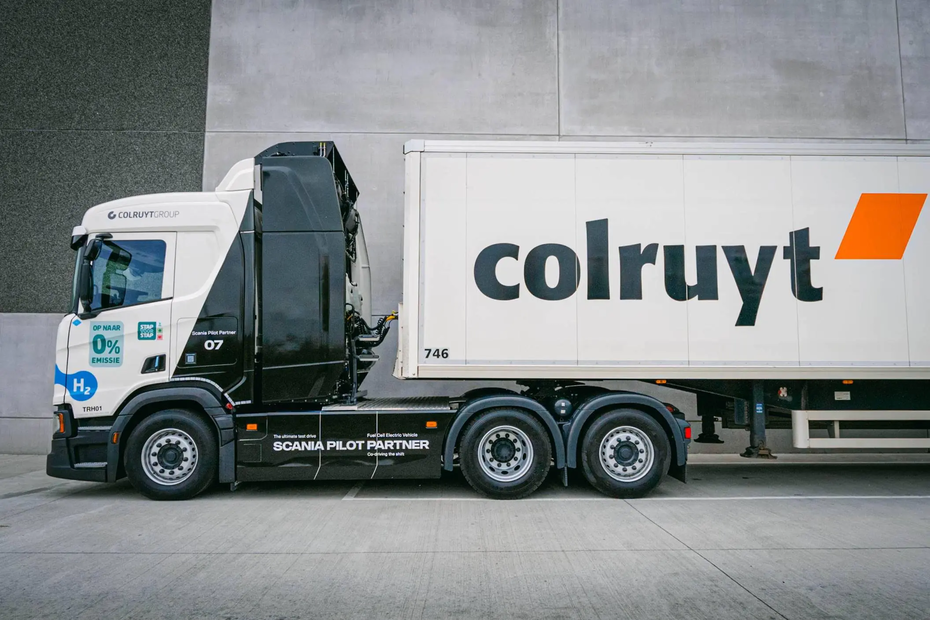
■ 제목: Colruyt Group and Scania Are Pioneering the Use of Hydrogen Trucks in Day-to-Day Operations
■ 출처: Fuel Cells Works
■ 작성자: Fuel Cells Works
■ 발행일: August 21, 2026 at 11:43 AM EDT
■ 본문:
As part of its sustainable transport strategy, Scania continues to actively research various innovative technologies and energy sources. Whilst battery-electric transport forms the core of this strategy, Scania also regards hydrogen as an interesting complement for specific transport applications. The delivery of two hydrogen fuel cell trucks (FCEVs) to Colruyt Group forms part of this ongoing research into the potential and practical applicability of hydrogen in heavy goods transport. For Colruyt Group, this forms part of its established plan to strive for more sustainable and 100 per cent zero-emission goods transport, in which battery-electric and hydrogen-electric vehicles play a key role.
Scania Pilot Partner programme
The Scania Pilot Partner initiative, established in 2021, is the company’s collaborative platform for innovation with selected customers. Within the programme, a wide range of technologies and methods are evaluated and tested: from battery-electric to internal combustion engines with range extenders and emerging alternatives such as hydrogen fuel cells.
The aim is to assess technical performance, operational feasibility and commercial potential. As part of this five-year pioneering project, Colruyt Group is the first and only Belgian customer to incorporate two Scania hydrogen trucks into its day-to-day operations. Scania has developed only around twenty vehicles in this series, which are being tested under real-world conditions in a select number of countries. This underlines the unique and exclusive nature of the project.“By testing in real-world transport environments, we are learning what works best in practice and how we can accelerate progress,” explains Tony Sandberg, Head of Scania Pilot Partner.
The trial with hydrogen trucks does not alter Scania’s strategy for the decarbonisation of the transport system, which remains focused on direct electrification. However, it is one of several trials within the Pilot Partner programme aimed at understanding how various energy carriers and powertrains perform. The aim is to gain insight into the real strengths and weaknesses of other technologies and fuels.
Scania Fuel Cell Electric Vehicle (FCEV)
The vehicle is a fully electric hydrogen fuel cell truck. It is fitted with a fuel cell with a maximum output of 300 kW, which generates electricity from hydrogen to support the batteries whilst driving. The electric powertrain delivers a continuous power output of 400 kW and also provides up to 480 kW of regenerative braking power for maximum energy efficiency.
The tractor unit is configured as a three-axle 6x2 with a steered trailing axle, ensuring high load capacity combined with excellent manoeuvrability. With a maximum authorised train weight of 50 tonnes, the vehicle is suitable for heavy-duty transport applications over longer distances.
The hydrogen is stored in tanks with a total capacity of 56 kg at a pressure of 700 bar. The trucks will refuel with hydrogen at existing and future HRS hydrogen refuelling stations in Halle and Ollignies. Refuelling takes place via an SAE J2600-H70 filler nozzle with a maximum filling rate of 60 grams of hydrogen per second. In addition, the vehicle is equipped with two battery packs with a total gross energy capacity of 356 kWh. These can be charged externally via a CCS2 Combo charging connector with a maximum charging current of 500 amps, providing a charging power of up to 375 kW.
Thanks to the combination of battery-electric propulsion and a hydrogen fuel cell, the truck achieves a range of up to approximately 800 kilometres, whilst operating completely emission-free. The vehicle is also fitted with a Scania bumper that complies with the European IVD (Increased Vehicle Dimensions) directive. This means the tractor-trailer combination is legally permitted to be longer than the traditional maximum length of 16.5 metres, without compromising on load capacity. The extra length is utilised to improve aerodynamics, safety and energy efficiency.
Close collaboration
“As a retail group with sustainability in our DNA, we are also making our freight transport more sustainable, step by step,” says Lieselot Rouquart, Division Manager Transport at Colruyt Group.“We aim to make our own freight transport completely emission-free by 2030, using battery-electric and hydrogen-electric vehicles. By 2035, we will take the next step: our goods transport will then run entirely on green electricity and green hydrogen. This is an important step in the further expansion of our heavy-duty fleet. We are therefore looking forward to thoroughly testing this new Scania.”
The collaboration between Scania and Colruyt Group on this hydrogen project dates back to 2020. Since then, both parties have jointly developed the hydrogen concept further into the vehicle that is now being used in day-to-day logistics operations. In doing so, they considered not only the technical capabilities of the hydrogen-electric powertrain, but also its practical suitability for Colruyt Group’s distribution activities. Thanks to this close collaboration, the vehicle concept, infrastructure, operational requirements and logistics processes could be optimally aligned.
A key challenge within the project was the type-approval of the vehicle. As the configuration did not fully comply with existing European vehicle regulations, the vehicle as a whole had to be individually approved before it could be used on public roads in Belgium. This required an intensive process in which Scania, the Colruyt Group, certification bodies and various technical partners worked together to obtain all the necessary component certificates and approvals. The entire type-approval process took around one and a half years and ultimately resulted in the vehicle being authorised for road trials on Belgian roads.
■ Photo Caption:
Image Source: Colruyt
■ Source Notice:
This content has been reproduced from the original source without modification for internal reference purposes. All rights remain with the original publisher. A separate internal link is provided solely for viewing convenience.
![[독일] Toyota-Caetano 수소버스 6대, Rems-Murr 지역 대중교통서 3개월 실운행 검증…10월 정규운행 전환](https://files.mobisight.co.kr/uploads/managed/pasted_1788399604698_2roxd6.png)
![[독일] 대중교통 운영사 RVK, Solaris·Wrightbus 수소버스 108대 도입 완료…FC버스 160대로 확대](https://files.mobisight.co.kr/uploads/managed/pasted_1788399426483_fb9poo.png)