■ 제목: Remstal Hydrogen Buses Clear First Three-Month Reliability Test as Full Service Nears
■ 출처: Fuel Cells Works
■ 작성자: FCW Team
■ 발행일: August 26, 2026 at 11:24 AM EDT
■ 본문:
Six fuel-cell buses are now completing full weekday duties without disruption in Germany’s Rems-Murr district, while seven articulated models and on-site green hydrogen production are due to follow
- have completed their first three months of trial service reliably, including full daily rotations during recent high temperatures.
- The fleet is expected to move fully into regular service from October, with seven additional articulated hydrogen buses due around year-end and local green hydrogen production targeted for early 2027.
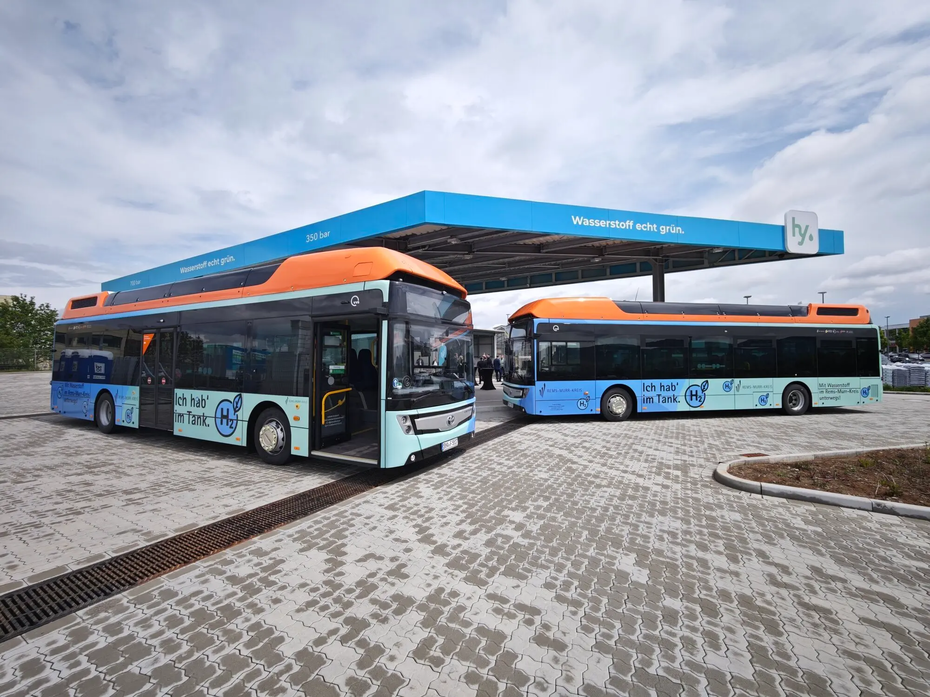
Germany’s Rems-Murr district has given a positive early assessment of its first six hydrogen buses after almost three months of trial operation, with the vehicles now running almost every weekday and completing entire scheduled duties without disruption.
The fuel-cell buses entered testing at the end of May and refuel at the new hydrogen station at Waiblinger Tor. According to Daniel Wiedmann, head of the district’s public-transport office, they have also continued operating reliably through the high temperatures experienced in recent weeks.
The current plan is to move from trial operation into full regular service from October 2026. That is later than the original target, which had envisaged progressively integrating the buses into normal service by August 1, but the district’s latest update does not identify reliability problems as the cause of the revised schedule.
Seven Articulated Hydrogen Buses Coming Next
The six vehicles are only the first stage.
A further seven articulated hydrogen buses are expected towards the end of 2026 and are scheduled to enter service from January 2027.
Three hydrogen-based route packages are planned across Fellbach/Kernen, Waiblingen and Weinstadt/Korb.
The latest timetable calls for the entire regular bus operation in Weinstadt/Korb to become zero-emission from January 2027, followed by Fellbach/Kernen from August 2027. A large share of Waiblingen’s regular service will also operate with zero-emission vehicles, while the remaining service will use vehicles classified as “clean,” which the district says produce 90% less CO₂ than conventional diesel buses.
The district has also recently tendered for up to nine additional fuel-cell solo buses, with potential deliveries between December 2026 and January 2027, although the framework agreement does not oblige the operator to order the full quantity.
Green Hydrogen Production Still Waiting on Transformer
The Waiblingen station is currently operational, but one of the project’s most important elements is still missing: its on-site electrolyser.
The required approval has now been obtained, but the electrolyser cannot operate until a transformer is delivered, currently expected towards the end of 2026. Local green hydrogen production is therefore expected to begin in early 2027.
Long term, the plan is to use regional renewable electricity to manufacture green hydrogen directly at the Waiblingen site and supply it to public transport rather than relying entirely on hydrogen transported from elsewhere.
HY.Waiblingen is backed by Stadtwerke Waiblingen, ITEM UG and GP Joule and forms part of the wider H2Rivers programme. The district and city are jointly investing €11.7 million [about US$13.6 million], split equally, while HY.Waiblingen has secured another €5 million [about US$5.8 million] in federal funding.
District Says Hydrogen Fills Gaps Batteries Cannot Yet Cover
Rems-Murr is not positioning hydrogen as the only zero-emission bus technology.
The district is continuing to monitor both battery-electric and fuel-cell buses and says the appropriate drivetrain depends heavily on local conditions.
Its argument for hydrogen is practical: expansion of rural electricity networks and depot charging is not progressing quickly enough to electrify every route, while experience with battery buses in the nearby Schwäbischer Wald has shown that demanding terrain and cold temperatures can still create operational range constraints.
That makes Remstal a useful test of a complementary strategy rather than a simple battery-versus-hydrogen competition.
Fuel-cell buses can be refuelled quickly and retain long daily operating range, but their economics will depend on hydrogen price, station utilisation and the cost of producing green hydrogen locally.
The first three months answer only one of those questions: the buses can complete the work reliably.
The next test begins when the pilot becomes full regular service, the articulated fleet arrives and the electrolyser starts supplying locally produced hydrogen.
■ Source Notice:
This content has been reproduced from the original source without modification for internal reference purposes. All rights remain with the original publisher. A separate internal link is provided solely for viewing convenience.
![[벨기에] Scania, 300kW 연료전지 수소트럭 Colruyt 실물류 투입…약 20대 글로벌 실증](https://files.mobisight.co.kr/uploads/managed/pasted_1788399536538_vdypki.png)
![[독일] 대중교통 운영사 RVK, Solaris·Wrightbus 수소버스 108대 도입 완료…FC버스 160대로 확대](https://files.mobisight.co.kr/uploads/managed/pasted_1788399426483_fb9poo.png)